 02
02Jyotirlinga · Sacred Shiva Kshetra
Mahakaleshwar Jyotirlinga
Ujjain, Madhya Pradesh
04:00–06:00
Bhasma Aarti (advance booking required)
07:00–13:00
Morning Darshan
15:00–19:00
Afternoon Darshan
19:00–21:00
Evening Aarti & Darshan
02Jyotirlinga · Sacred Shiva Kshetra
Ujjain, Madhya Pradesh
04:00–06:00
Bhasma Aarti (advance booking required)
07:00–13:00
Morning Darshan
15:00–19:00
Afternoon Darshan
19:00–21:00
Evening Aarti & Darshan
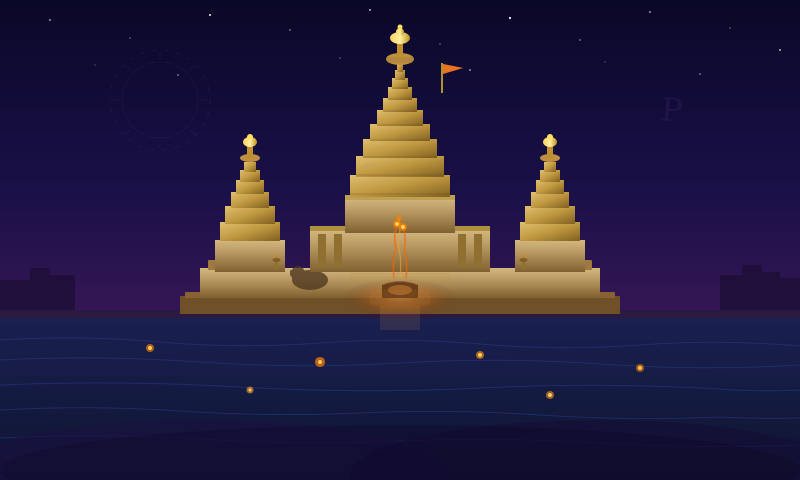
Temple Illustration
Photo gallery coming soon — curated images of Mahakaleshwar Jyotirlinga and its surroundings.
Mahakaleshwar Jyotirlinga in Ujjain is unique among all 12 Jyotirlingas in two fundamental ways: it is the only one considered Swayambhu — self-manifested, not installed by human hands — and its Shivalinga is Dakshinamukhi, facing south, the direction of Yama, the lord of death.
This southward-facing orientation is not incidental. Mahakaleshwar represents Shiva in his form as Mahakal — the lord and master of time itself (Maha = great, Kala = time/death). While Kashi Vishwanath grants liberation at the moment of death, Mahakaleshwar governs the very force of time and its dissolution. To worship Mahakal is to step outside of time — to touch that which is eternal in a world of constant flux.
Ujjain (ancient Avantika) sits on the meridian that ancient Indian astronomers used as the prime meridian — the Indian zero degree longitude for calculating astronomical and astrological positions. The Tropic of Cancer passes through Ujjain, making it a node of cosmic significance in Vedic astronomical thought. The Kshipra river that runs through Ujjain is considered among the most sacred rivers in the Shaiva tradition.
The Skanda Purana, Shiva Purana, and Mahabharat all mention Mahakaleshwar. The Avantika Khanda of the Skanda Purana describes Ujjain as one of the seven Moksha-puri — cities capable of granting liberation. In the Meghaduta, Kalidasa describes Ujjain as the city of Mahakal with great reverence, placing it at the centre of his protagonist cloud's journey.
The current temple structure has five levels, with the Mahakal linga in the lowest (underground) level — the Omkareshwar temple occupying the second level, and three other shrines above. The underground sanctum — dark, enclosed, approached by descent — creates a space of inwardness and gravity rare in Indian temple architecture.
Every twelve years, Ujjain hosts the Kumbh Mela, known as Simhastha — one of the largest human gatherings on earth. During Simhastha, the Kshipra river itself becomes a tirtha of the highest order, and bathing at the Mahakal ghat is considered equivalent to visiting all seven sacred cities at once.
The Bhasma Aarti is Mahakaleshwar's most extraordinary ritual — performed before sunrise, between 4 and 6 AM. Fresh ash (bhasma) — traditionally from the cremation pyres of Ujjain — is smeared on the Shivalinga as priests perform the aarti. The ash, symbolising the impermanence of physical form and the reality of Shiva beyond birth and death, transforms the ritual into a direct confrontation with mortality and eternity.
Attendance at Bhasma Aarti requires advance booking. The experience — in the dim underground sanctum, with drums, the smell of incense, and the sacred ash — is considered among the most transformative in any Hindu pilgrimage.
Nityapuja is performed five times daily. Rudrabhishek with Ganga water, milk, honey, and curd is offered by devotees at dedicated times. Monday worship (Somvar puja) is particularly significant. During Shravan, special abhisheks and processions are held daily.
On Mahashivratri, Mahakaleshwar is worshipped through the night in four prahar aartis. The Somvati Amavasya — new moon falling on a Monday — draws enormous crowds for special Mahakal pujas.
Ujjain Railway Station (UJN) is 2 km from the temple — well connected to Mumbai, Delhi, Indore, Bhopal, and Ratlam. Direct trains run from Mumbai (Avantika Express, ~12 hrs), Delhi (Malwa Express, ~14 hrs), and Indore (30 min). Indore Airport (IDR) is 55 km away (approx. 1.5 hrs by road) — shared cabs and buses run hourly from Indore to Ujjain. From Bhopal, Ujjain is 190 km (3 hrs by road or 2.5 hrs by train). Local auto-rickshaws from Ujjain Railway Station to the temple cost ₹40–60. The temple is in the heart of Ujjain city, 500 m from the main Mahakal chowk market. Photography is not permitted inside the sanctum. Modest dress is required — shoulders and knees covered. Footwear must be removed before entering.
Timings may vary on festival days and may change seasonally. Verify with the temple administration before your visit.
Mahashivratri (February–March) is the most auspicious time, with all-night rituals. Shravan month (July–August) brings intensive Shiva worship and large pilgrimage groups. Kartik Purnima. Simhastha Kumbh (every 12 years, next in 2028) transforms the entire city into a sacred space. November to February offers the most comfortable weather for extended visits.
What makes Mahakaleshwar different from other Jyotirlingas?
Mahakaleshwar is the only Jyotirlinga that is both Swayambhu (self-manifested) and Dakshinamukhi (facing south — toward the realm of death). This orientation reflects Shiva's role as Mahakal, the lord of time and death. Its Bhasma Aarti — performed with sacred ash before sunrise — is one of the most rare and powerful rituals in Hinduism.
What is the significance of the Bhasma Aarti at Mahakaleshwar?
The Bhasma Aarti is performed in the pre-dawn hours (4–6 AM). The linga is worshipped with sacred ash, symbolising the cycle of creation and dissolution. The ritual represents Shiva's nature as destroyer of ego and impermanence — and the worshipper's surrender to the force of time. Attendance requires advance booking and is one of the most sought-after spiritual experiences in India.
How do I book Bhasma Aarti at Mahakaleshwar?
Bhasma Aarti at Mahakaleshwar requires advance booking through the official Mahakal temple website (mahakaleshwar.nic.in) or the MP tourism portal. Slots open 30 days in advance and fill quickly, especially during Shravan and Mahashivratri. A limited number of seats are available daily — arrive at the temple by 3:30 AM on the day of booking. There is no booking for general darshan; only Bhasma Aarti requires prior registration.
What are the Mahakaleshwar temple darshan timings?
Mahakaleshwar temple is open daily. Bhasma Aarti (advance booking required) runs from 4:00–6:00 AM. Morning darshan is from 7:00 AM to 1:00 PM. Afternoon darshan is from 3:00–7:00 PM. Evening aarti and darshan runs from 7:00–9:00 PM. The temple is closed for a short period mid-afternoon. Timings may vary during festivals — check locally on arrival.
What is the entry fee at Mahakaleshwar temple?
General darshan at Mahakaleshwar is free of charge. There is a nominal fee for the Bhasma Aarti booking (approximately ₹200–250 per person, subject to revision). VIP darshan and Rudrabhishek puja bookings are available at additional cost through the temple trust. Photography inside the sanctum is not permitted.
How do I reach Mahakaleshwar from Indore?
Indore (IDR airport) is approximately 55 km from Mahakaleshwar temple in Ujjain — around 1.5 hours by road. Direct buses and shared cabs run frequently from Indore bus stand to Ujjain. From Ujjain Railway Station (UJN), the temple is 2 km by auto-rickshaw. Delhi, Mumbai, and Bhopal are all well connected to Ujjain by rail.
Is Mahakaleshwar temple good for Shani (Saturn) dosha?
Yes — Mahakaleshwar is one of the most powerful temples for Shani dosha remedies. Mahakal, as the lord of time (Kala), governs Saturn's domain. Devotees experiencing Shani Sade Sati or Shani Mahadasha visit Mahakaleshwar for relief, offering oil, black sesame (til), and dark flowers to the linga. The Monday Somvar puja and Saturday Shani puja are particularly significant for this purpose.
✦ AI-Powered Itinerary
Tell us about yourself — Daanyam will craft a personalised yatra plan with darshan timings, auspicious dates, and practical guidance.
Mahakaleshwar Jyotirlinga is open: Year-round
Best visited October–March. Summers can be humid. Janmashtami (Aug/Sep) is the peak festival.