 01
01Jyotirlinga · Sacred Shiva Kshetra
Kashi Vishwanath Jyotirlinga
Varanasi, Uttar Pradesh
03:00–04:00
Mangala Aarti
04:00–11:00
Morning Darshan
12:00–17:00
Afternoon (Bhog)
17:00–21:00
Evening Darshan
01Jyotirlinga · Sacred Shiva Kshetra
Varanasi, Uttar Pradesh
03:00–04:00
Mangala Aarti
04:00–11:00
Morning Darshan
12:00–17:00
Afternoon (Bhog)
17:00–21:00
Evening Darshan
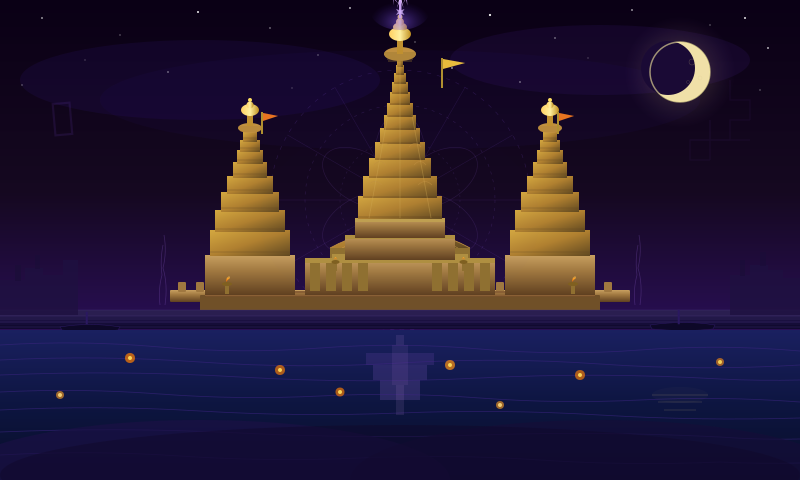
Temple Illustration
Photo gallery coming soon — curated images of Kashi Vishwanath Jyotirlinga and its surroundings.
Kashi Vishwanath Jyotirlinga stands in the ancient city of Varanasi — one of the oldest continuously inhabited cities on earth — on the western bank of the Ganga. It is considered the most sacred of all 12 Jyotirlingas, the physical manifestation of Shiva as the Lord of Light.
The word Kashi means "the city of light" in Sanskrit. Vishwanath means "Lord of the Universe." Together, Kashi Vishwanath represents Shiva as the illuminating force that dissolves darkness — both worldly and karmic.
According to the Skanda Purana, it was in Kashi that Shiva himself planted his luminous linga — the Jyotirlinga — as a pillar of endless light (jyotistambha) that pierced through both earth and sky, defying all spatial boundaries. When Brahma and Vishnu raced to find the pillar's ends and could not, they recognized Shiva's supremacy. Varanasi is thus considered the point on earth where divine and human realms most closely intersect.
The current Kashi Vishwanath temple structure, built in 1780 by Maharani Ahilyabai Holkar of Indore, replaced earlier temples that had been destroyed and rebuilt multiple times over centuries. The gold-plated shikhara (spire) and twin domes were donated by Maharaja Ranjit Singh in the 19th century, using over 800 kilograms of gold. The Gyanvapi mosque stands adjacent on land where an older temple once stood — a historical tension that continues to shape the site's character.
Kashi holds a unique place in Hindu eschatology. It is believed that dying within the boundaries of Kashi — the Varanasi city limits — grants moksha, or liberation, regardless of one's accumulated karma. This belief has made it a destination not just for pilgrims but for those seeking a conscious death in the presence of Shiva. The Manikarnika and Harishchandra cremation ghats on the Ganga have burned continuously for thousands of years, attended by the Dom community who tend the sacred fires.
The Ganga here flows northward — an anomaly in the river's course — which is considered deeply auspicious in Hindu thought. Bathing in the Ganga at Varanasi, particularly at dawn, is believed to wash away accumulated sins across lifetimes.
Kashi is also the spiritual seat of the Shaiva tradition. The Kashi Khand of the Skanda Purana dedicates extensive text to the sacred geography of Varanasi, naming hundreds of tirthas (pilgrimage sites), temples, and sacred tanks within the city limits. For generations of Shaiva scholars, Varanasi was both homeland and university — the city where Adi Shankaracharya debated, where Kabir sang, where Tulsi Das composed the Ramcharitmanas.
Daily worship at Kashi Vishwanath follows a sequence of six aartis that mark the passage of the day. The Mangala Aarti at dawn — held before sunrise — is considered especially powerful. Devotees queue through the night to attend.
The Shringar (adornment) aarti follows in the morning. Bhog (food offering) is presented at midday. Sandhya (twilight) aarti marks the transition into evening. Shringar aarti is again performed at night, and Shayan (resting) aarti closes the day's worship.
Rudrabhishek — the ritual bathing of the Shivalinga with milk, honey, curd, ghee, and Ganga water while chanting the Rudrashtadhyayi — is the most complete act of worship. Many devotees arrange for Rudrabhishek on auspicious occasions, birthdays, and death anniversaries.
Panchamrit abhishek (bathing with five sacred substances) is performed on Mondays and during Shravan month. On Mahashivratri, the temple stays open through the night for continuous darshan, with special abhisheks every three hours corresponding to each prahar (time period).
Jalabhishek — offering water carried from the Ganga directly onto the Shivalinga — is a daily practice for lakhs of devotees. The act is considered a direct dialogue between the devotee and Shiva.
Varanasi Junction (BSB) railway station is 2 km away. Lal Bahadur Shastri International Airport is 26 km from the temple. Local auto-rickshaws and cycle rickshaws connect the station to Dashashwamedh Ghat, from which the temple is a short walk through the old city lanes.
Timings may vary on festival days and may change seasonally. Verify with the temple administration before your visit.
October to March for pleasant weather and manageable crowds. Mahashivratri (February–March) draws lakhs of devotees and the temple remains open all night. Shravan (July–August), the month dedicated to Shiva, is considered most sacred — Kanwariyas carry Ganga water from Sultanganj to Varanasi on foot. Kartik month (October–November) and Dev Deepawali on Kartik Purnima, when the entire Ganga ghats light up with earthen lamps, are particularly meaningful times to visit.
What is the significance of the Kashi Vishwanath Jyotirlinga?
Kashi Vishwanath is believed to be the most powerful of the 12 Jyotirlingas. Shiva is said to reside here permanently. According to the Skanda Purana, anyone who dies within Kashi's boundaries receives moksha — liberation from the cycle of rebirth — through Shiva's Taraka mantra whispered in the ear of the dying.
What is the best time to visit Kashi Vishwanath Temple?
October to March offers comfortable weather. The Shravan month (July–August) is spiritually the most significant, drawing millions of Shiva devotees. Mahashivratri sees all-night worship and is the most auspicious single occasion to visit.
✦ AI-Powered Itinerary
Tell us about yourself — Daanyam will craft a personalised yatra plan with darshan timings, auspicious dates, and practical guidance.
Kashi Vishwanath Jyotirlinga is open: Year-round
Best visited October–March. Summers can be humid. Janmashtami (Aug/Sep) is the peak festival.