Temple Illustration
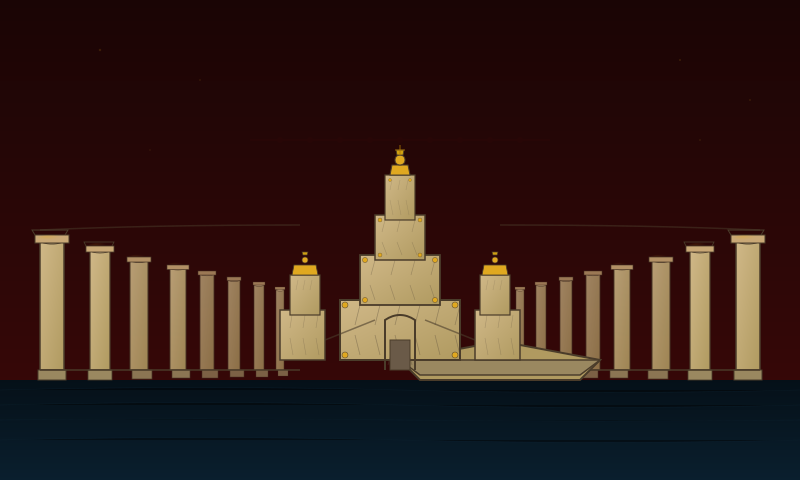
Photo gallery coming soon — curated images of Rameshwaram Dham and its surroundings.
About
Rameshwaram, situated on Pamban Island in the Gulf of Mannar off the southeastern coast of Tamil Nadu, is uniquely the only pilgrimage site in India that holds dual sacred status — it is simultaneously the southernmost of the four Char Dhams established by Adi Shankaracharya and one of the twelve Jyotirlingas of Lord Shiva. This convergence of Shaiva and Vaishnava pilgrimage traditions makes Rameshwaram one of the most theologically significant kshetras in the country.
The presiding deity of the Ramanathaswamy temple is Lord Shiva, worshipped as Ramanathaswamy — "the Lord worshipped by Rama." The Ramayana records that Lord Rama, before launching his campaign against Lanka, installed a Shivalinga at this spot to seek Lord Shiva's blessings and to perform prayaschitta for the act of having killed Ravana, who was a Brahmin. The Valmiki Ramayana and the Uttara Kanda both describe this event, making Rameshwaram inseparable from the Ramayana geography.
The Ramanathaswamy temple is architecturally celebrated for its magnificent corridor — the longest temple corridor in India, stretching approximately 1,200 metres and lined with 1,212 ornately carved pillars. The outer corridor alone runs 400 metres per side and reaches 8.23 metres in height. Construction of the temple in its present form began in the 12th century under the patronage of Pandyan kings and was extended significantly by the Setupati rulers of Ramanathapuram.
The island is also associated with Adam's Bridge (Ram Setu) — the chain of limestone shoals connecting Pamban Island to Mannar Island in Sri Lanka — which Hindu tradition identifies as the bridge built by Rama's army of vanaras. Devotees may offer Shiva Seva inspired by this sacred kshetra.
Spiritual Significance
- The only pilgrimage site in India that is simultaneously a Char Dham and a Jyotirlinga — the southernmost point of both sacred circuits.
- The temple's corridor is the longest of any Hindu temple in India, at approximately 1,200 metres, lined with 1,212 ornately carved pillars.
- Associated with Lord Rama's installation of the Shivalinga and performance of puja before the Lanka campaign, as recorded in the Valmiki Ramayana.
- The 22 sacred wells (theerthams) within the temple complex are each said to carry distinct curative and spiritual properties — ritual bathing in all 22 is prescribed for pilgrims.
- One of the four Pancha Bhuta Lingams of South India that represent the five elements — Rameshwaram represents Prithvi (earth).
Rituals and Traditions
The defining ritual of the Rameshwaram pilgrimage is the bath in the 22 theerthams — sacred wells within and around the temple complex, each fed by a distinct source and each believed to possess specific spiritual and curative properties. Pilgrims carry water from each well and pour it over themselves in succession, a practice believed to wash away accumulated karma and grant the merit equivalent to bathing in all the tirthas of India.
The Abhishek of the two Shivalingas in the inner sanctum is the core ritual offering — the Ramalinga (installed by Rama himself according to tradition) and the Vishvalinga (brought from Kashi by Hanuman). The Ramalinga is worshipped first at every aarti, honouring the sequence established by Rama. Temple priests perform Panchamrit Abhishek with milk, curd, ghee, honey, and sugar daily.
The Sethu Snanam (bathing at the southern tip of the island, facing Sri Lanka) is considered an especially purifying act. Pilgrims who complete both the Rameshwaram theertham circuit and the Sethu Snanam are said to have fulfilled one of the most complete pilgrimage acts available in the Shaiva tradition.
Best Time to Visit
October to April is ideal — avoiding the summer heat (April–June) and the northeast monsoon (October–December brings heavy rain to this coast, though the temple remains fully operational). Maha Shivaratri (February–March) and the Brahmotsavam festival (March–April) draw the largest gatherings and represent the most spiritually charged times to visit. The island is accessible year-round by both the Pamban railway bridge and road.
How to Reach Rameshwaram Dham
Rameshwaram is located on Pamban Island, connected to mainland Tamil Nadu by the Pamban Bridge (road) and the Pamban Railway Bridge — one of India's most scenic rail crossings.
By rail: Rameshwaram has its own railway station (Rameswaram Station) connected via Mandapam on the mainland. Key trains include the Rameswaram Express (Chennai–Rameswaram, approximately 12 hours), the Sethu Express (Madurai–Rameswaram), and the Rameshwaram–Chennai Egmore Express. From Madurai (165 km), multiple trains and buses run daily.
By air: The nearest airport is Madurai Airport (173 km, about 3.5 hours by road). Madurai is connected to Chennai, Bengaluru, Mumbai, Delhi, and Hyderabad. Taxis from Madurai to Rameshwaram cost approximately ₹2,000–2,500 one way; shared cabs are also available.
By road: Regular state buses run from Madurai (SETC and private operators) to Rameshwaram, taking 3.5–4 hours. From Chennai, it is approximately 575 km via NH-85. The Pamban bridge road offers dramatic views over the Palk Strait.
Within Rameshwaram: The Ramanathaswamy temple is at the centre of the island town. The 22 theerthams extend both within and just outside the temple complex. Cycle rickshaws and autos navigate the narrow temple streets; the Agnitheertham beach (first theertham) is adjacent to the east gopuram.
Darshan Timings
Timings may vary on festival days. Verify locally before visiting.
Frequently Asked Questions
Is Rameshwaram both a Char Dham and a Jyotirlinga?
Yes — Rameshwaram holds the rare distinction of being counted in both the Char Dham circuit (as the southern Dham in the system established by Adi Shankaracharya) and among the 12 Jyotirlingas of Lord Shiva. This dual status makes it a site of convergence for both Vaishnava and Shaiva pilgrimage traditions. The Jyotirlinga aspect focuses on the Ramanathaswamy form of Shiva; the Char Dham aspect situates it within the geographical pilgrimage circuit that traverses the four cardinal directions of the Indian subcontinent.
Why are there two Shivalingas in the Ramanathaswamy temple?
According to tradition, Rama sent Hanuman to Kashi to bring a Shivalinga for the puja before the Lanka campaign. Hanuman took longer than expected, and Sita fashioned a Shivalinga from the sand of Rameshwaram (the Ramalinga) for Rama to worship on time. When Hanuman returned with the Kashi Shivalinga (the Vishvalinga), he was upset that his effort had been preempted. To honour Hanuman, Rama decreed that the Vishvalinga should be worshipped first at every ritual occasion — a tradition still followed today, where the Vishvalinga receives the first aarti and the first offering, even though the Ramalinga installed by Rama is the primary presiding deity of the temple.
What are the Ramanathaswamy temple timings?
The Ramanathaswamy temple is open from 5:00 AM to 1:00 PM and again from 3:00 PM to 9:00 PM. The last darshan is around 9:30 PM. The 22 theertham bath circuit is typically done in the morning before entering the inner sanctum. Entry to the temple is free; however, a paid special darshan (₹50–100) allows bypass of the general queue. Photography is not permitted inside the temple corridors.
How long does the 22 theertham bath circuit take and what should I expect?
The circuit of 22 theerthams takes approximately 2–3 hours when done properly. Each well is attended by a temple priest (theertham karar) who pours the well water over the pilgrim from a brass pot, reciting a specific mantra for that theertham. The water is poured over the head and upper body — pilgrims typically wear a thin wet dhoti or sari throughout. It is customary to tip the attendant priest (approximately ₹10–20 per well is common). Begin the circuit at Agnitheertham (the sea shore, east of the temple), then proceed through the wells inside and outside the temple complex. Carry a change of dry clothes.
✦ AI-Powered Itinerary
Plan Your Rameshwaram Dham Yatra
Tell us about yourself — Daanyam will craft a personalised yatra plan with darshan timings, auspicious dates, and practical guidance.
Rameshwaram Dham is open: Year-round
October–April is most pleasant. Maha Shivaratri sees massive pilgrim crowds.

Daanyam · Gau Seva
Shiva Seva, Inspired by This Sacred Kshetra
Nourish sacred cows at our gaushala — performed by verified kartas on the auspicious day you choose.
Explore Other Char Dhams