Temple Illustration
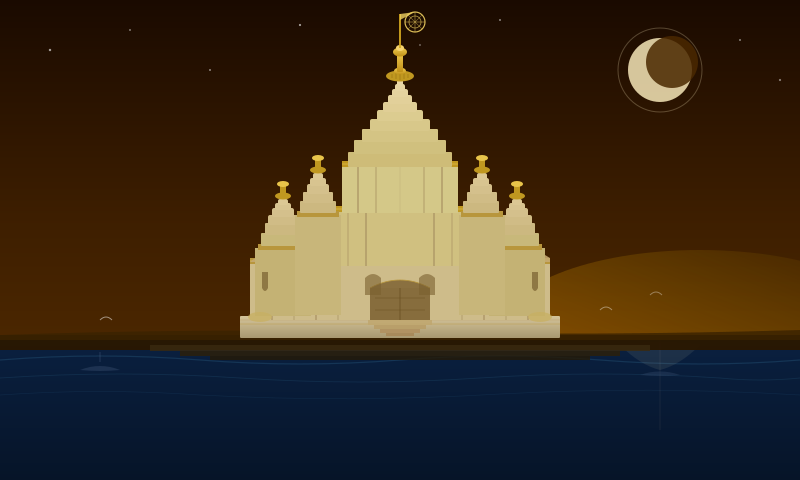
Photo gallery coming soon — curated images of Dwarka Dham and its surroundings.
About
Dwarka, situated on the western coast of the Saurashtra peninsula in Gujarat where the Gomti river meets the Arabian Sea, is the westernmost of the four Char Dhams and one of the seven sacred cities (Sapta Puri) of Hinduism. It is revered as the ancient kingdom of Lord Krishna — the Dvaravati or Kushasthali of the Mahabharata and Bhagavata Purana — the city that Krishna built upon leaving Mathura, that the sea is said to have submerged after his departure from the world.
The Dwarkadhish temple — whose presiding deity is Trivikrama, a four-armed form of Lord Vishnu holding a conch, disc, mace, and lotus — rises five storeys above the Gomti ghat, crowned by a 43-metre shikara bearing a flag that changes four times daily. The main shrine is believed to be built over the original dwarka-sadan of Krishna himself, though the current structure dates largely to the 16th century CE with foundations attributed to Vajranabha (Krishna's great-grandson) in ancient texts.
Dwarka carries a unique archaeological significance among pilgrimage sites — marine archaeological surveys off the coast of Dwarka have uncovered submerged stone structures, anchors, and artefacts dating to 1500–3000 BCE, lending partial historical support to the Puranic account of a drowned city. The site continues to be studied by the National Institute of Oceanography.
The Char Dham pilgrimage traditionally begins at Yamunotri or Gangotri and ends at Dwarka or Puri, completing a full east-west and north-south traversal of the subcontinent. For many Vaishnava pilgrims, completing the circuit connecting Badrinath, Dwarka, Puri, and Rameshwaram is considered the fulfilment of a complete life of devotion. Devotees may offer Vishnu Seva inspired by this sacred kshetra.
Spiritual Significance
- Westernmost of the four Char Dhams and one of the seven sacred cities (Sapta Puri) of Hinduism.
- Revered as the ancient kingdom of Lord Krishna — Dvaravati — described in the Mahabharata and Bhagavata Purana.
- The Dwarkadhish temple is one of the 108 Divya Desams celebrated in the devotional hymns of the Alvars.
- Marine archaeological surveys off the coast of Dwarka have uncovered submerged ancient structures supporting the Puranic account of a sunken city.
- One of the 51 Shakti Peethas — the right cheek of Goddess Sati is said to have fallen here, consecrating the site.
Rituals and Traditions
The daily ritual schedule at Dwarkadhish begins before dawn with the Mangala aarti, during which the image of the Lord is adorned with a special sringara (divine dress) that changes five times during the day — each change marking a distinct state of the Lord's activity from awakening to sleep. This panchkalyanaka sringara is a distinctive tradition of the Pushti Marg sampradaya, the devotional school founded by Vallabhacharya.
The Janmashtami celebrations at Dwarka are among the most elaborate in India. The night of Krishna's birth is observed with an all-night vigil, mass readings of the Bhagavatam, and a midnight abhishek of the Lord's image with panchamrit and fragrant substances. The temple forecourt — capable of holding thousands of devotees — fills entirely during this period.
The Gomti Snan (ritual bathing in the Gomti river at the Gomti ghat adjacent to the temple) is considered essential before entering the temple. The Panchjanya conch — displayed at the temple and believed to be the original conch of Krishna — is blown during major aratis, its sound considered deeply purifying for devotees present.
Best Time to Visit
October to March is the most comfortable season, avoiding the intense summer heat of Gujarat (April–June) and the monsoon (July–September). Janmashtami (August) and Holi (March) draw the largest gatherings and are the most spiritually charged times to visit, though accommodation should be booked well in advance. The Dwarkadhish temple is open year-round, unlike the Himalayan dhams.
How to Reach Dwarka Dham
Dwarka is well-connected by rail and road. The Dwarka railway station on the Ahmedabad–Okha broad-gauge line receives direct trains from major cities. Key trains include the Saurashtra Mail (Mumbai–Okha), the Dwarka Express (Ahmedabad–Okha), and the Jam Nagar–Dwarka Passenger. Okha, 32 km from Dwarka, is the railhead for Bet Dwarka ferry services.
By air: The nearest airport is Jamnagar Airport (137 km, ~2 hours by road), which has flights from Mumbai and Ahmedabad. Rajkot International Airport (220 km) offers more frequent connections. Taxis from both airports are readily available.
By road: Dwarka is 450 km from Ahmedabad and 960 km from Mumbai. The Gujarat state bus service (GSRTC) operates frequent direct buses from Ahmedabad (7–8 hours), Rajkot (4 hours), and Jamnagar (3 hours). Private taxis and AC coaches are also widely available. The National Highway (NH-947) connects Jamnagar to Dwarka directly.
Within Dwarka: The Dwarkadhish temple is located near the Gomti ghat in the heart of town and is a 10-minute walk from the railway station. Autorickshaws and electric carts connect the station, hotels, and ghats.
Darshan Timings
Timings may vary on festival days. Verify locally before visiting.
Frequently Asked Questions
Is the ancient city of Dwarka really submerged under the sea?
Marine archaeological surveys conducted by the National Institute of Oceanography and the Archaeological Survey of India have found submerged stone structures, anchors, and pottery off the coast of Dwarka, at depths consistent with the post-Ice-Age sea level rise. These findings — dated between 1500 and 3000 BCE — have been interpreted by some researchers as evidence of an ancient coastal settlement. The mainstream archaeological position remains cautious, but the discoveries have significantly elevated scholarly interest in the site.
What is the significance of the flag atop the Dwarkadhish temple?
The dhwaja (flag) atop the Dwarkadhish temple's 43-metre shikara bears the symbols of the sun and moon and is changed four times daily by a designated priest. The flag is donated by devotees as an act of seva, and it is considered especially meritorious to sponsor the offering of a flag. The flag change is accompanied by a ritual and is visible from a considerable distance, serving as an orienting landmark for pilgrims approaching the temple.
What are the Dwarkadhish temple timings?
The Dwarkadhish temple is open year-round. Morning darshan runs from 7:00 AM to 12:30 PM, and evening darshan from 5:00 PM to 9:30 PM. The Mangala Aarti begins at 6:30 AM. Avoid the afternoon break (12:30–5:00 PM) when the temple is closed. Entry for darshan is free, but donations at the inner sanctum are welcome. Photography inside the temple is not permitted.
What is the Panch Dwarka pilgrimage?
Panch Dwarka refers to five Krishna-associated sites around the Dwarka region: Dwarkadhish (the main temple), Bet Dwarka (the island believed to be Krishna's personal dwelling), Rukmini Devi temple (dedicated to Krishna's principal queen), Gomti Dwarka (the ghat area), and Nageshwar Jyotirlinga (one of the 12 Jyotirlingas, located 17 km from Dwarka). Completing all five sites is considered the complete Dwarka pilgrimage experience and is typically accomplished in 2–3 days.
Can non-Hindus enter the Dwarkadhish temple?
✦ AI-Powered Itinerary
Plan Your Dwarka Dham Yatra
Tell us about yourself — Daanyam will craft a personalised yatra plan with darshan timings, auspicious dates, and practical guidance.
Dwarka Dham is open: Year-round
Best visited October–March. Summers can be humid. Janmashtami (Aug/Sep) is the peak festival.

Daanyam · Gau Seva
Vishnu Seva, Inspired by This Sacred Kshetra
Nourish sacred cows at our gaushala — performed by verified kartas on the auspicious day you choose.
Explore Other Char Dhams